A scripted ghost is never scary
The obvious version of a browser ghost walks toward you the moment the page loads. Dark shape, two glowing eyes, never stops. It stops being scary after ten seconds, because you know exactly what it will do. A game is only tense if the threat has rhythm: build, hit, back off.
Horror POV is a single-player, first-person horror game that runs entirely in the browser, built by Anirudh Vasudevan as a personal one-day project in June 2026 to test whether an Alien: Isolation style pacing AI could ship as a static web page. You explore a haunted five-storey house in the dark, collect three hidden items, manage a sanity meter, and photograph a hooded presence. Then you open the front door and run for the graveyard gate while it hunts you.
The repo is private, so I will describe it rather than link it: three.js, TypeScript and Vite, about 4,600 lines across 30 source files, on Vercel, and the README says it was built with Claude Code. Three things made the ghost work: a tiny Director state machine, a sanity meter that reads the light field, and a collision trick that let five floors share one list.
Why a two-tier Director instead of a monster that chases
Before writing code I had a 275-line research document in the repo (docs/horror-games-research.md) that surveyed around forty horror games and pulled out two models. Alien: Isolation's Director tracks a "menace" gauge and forces the alien backstage on a cooldown once it peaks. Phasmophobia gates hunts behind a sanity meter that only darkness drains. The document is AI-generated; those two ideas became the spine.
The obvious approach was one Ghost class with a chase routine and random timers. That is flat. Instead I split the problem. A Director decides WHEN: it owns state and gauges and never touches a mesh. A Ghost decides WHERE and HOW: it reads the Director's state each frame and teleports, phases, fades, or freezes. I could tune pacing in one 137-line file and swap the ghost body for a downloaded GLB without touching the brain.
The engine choice came from the same document: three.js over Unity or Unreal, because a coding agent can write, run, screenshot and deploy it alone, and friends play by clicking a link. Horror hides most of its geometry in darkness, so web fidelity was enough. The constraint was time (every commit is dated June 13, 2026): no tests, one 18 by 14 metre footprint repeated across floors, box-primitive furniture.
What you do in the house
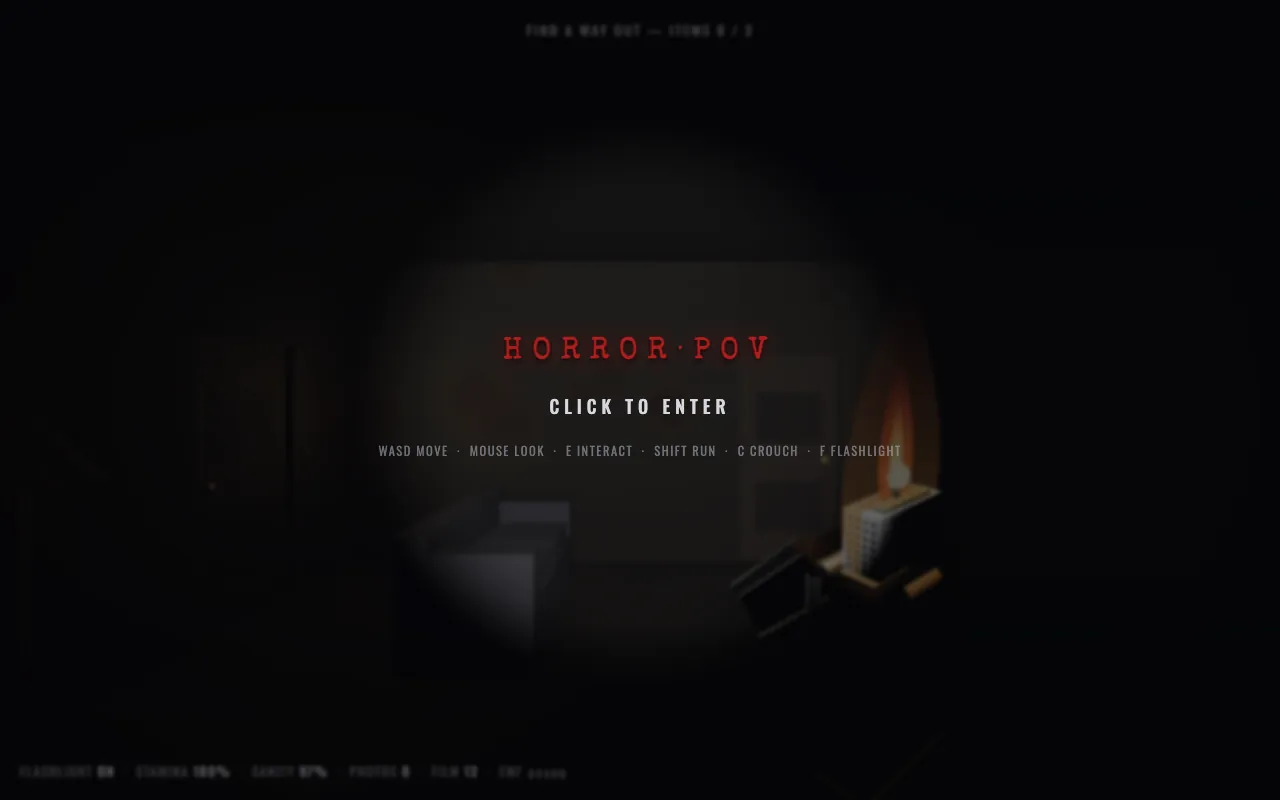
Horror POV starts with a click-to-play overlay that grabs pointer lock and starts the AudioContext. You wake in the entrance hall with a flashlight (F toggles it) and a Zippo lighter. WASD walks, Shift runs (which drains stamina and makes noise), C crouches, and E interacts with doors, switches, keys and items. Staircases in four corners connect two basements, the ground floor and two upper floors. Your sanity bar drains in darkness.
Right mouse raises the photo camera and left click fires the flash; you have twelve shots. If the ghost is in frame, within 20 metres and not behind a wall, the photo counts and the ghost comes for you. A hunt cuts the lights and the ghost phases straight at you. Collect the three hidden items, open the front door, and the final flee begins: the hunt never stops until you reach the gate.
Architecture
Horror POV has no backend. It is a static Vite build with one entry point, src/main.ts, which wires about twenty modules together and registers seventeen ordered (dt) => void systems on a Game loop that clamps delta time to 50 milliseconds.
Left to right: src/world/levelData.ts holds the house as data. Level.ts and Floors.ts turn it into meshes and push bounding boxes into one shared colliders array, which Player.ts slides against and Ghost.ts reads for line of sight. The Director lives inside the Ghost and reads sanity, which Sanity.ts computes from Level.lightLevelAt. Audio.ts scales the heartbeat and drone from a tension signal derived from menace. main.ts folds sanity and the hunt flag into a fear value and Hud.ts sets the vignette opacity from it. The only external pieces are offline: eight ElevenLabs mp3s from a gitignored script and a third-party ghost GLB with a procedural fallback.
The main choices:
| Layer | Choice | Why |
|---|---|---|
| Renderer | three.js 0.184, ACES tone mapping, PCF shadows | Runs from a link, flashlight shadows sell the darkness |
| Pacing AI | Director state machine with menace and noise gauges | Separates WHEN from WHERE, tunes in one file |
| Sanity | Summed point-light contributions at the player position | Lighting becomes a gameplay lever, not a flag per room |
| Collision | One flat AABB list with optional yMin and yMax bands | Five floors without a spatial structure or physics library |
| Perception | 2D slab-method segment vs AABB plus THREE.Frustum | Doors and walls block sight with no separate occlusion system |
| Audio | Web Audio synth layer with ElevenLabs mp3 overrides | Playable with zero samples, samples upgrade it when present |
How it works
The Director only ever sets state
src/ai/Director.ts has four states: retreat, lurking, manifest and hunting. In lurking, a timer calls rollEvent(sanity) every 3.5 seconds, which checks noise, then sanity, then falls through to a manifestation or an ambient whisper or bang. During a hunt, menace rises with time, proximity and sight, and the hunt ends when the 11 second timer expires or menace hits 1.
// src/ai/Director.ts
case "hunting": {
  const prox = ctx.distToPlayer < 6 ? (6 - ctx.distToPlayer) / 6 : 0;
  this.menace = Math.min(
    1,
    this.menace + ctx.dt * (0.04 + prox * 0.05 + (ctx.hasLoS ? 0.04 : 0)),
  );
  if (this.stateTimer <= 0 || this.menace >= 1) this.startRetreat();
  break;
}
startRetreat sets a 14 second cooldown and zeroes menace. That is the whole tension-and-release mechanism. The Director exposes one-frame flags, justEnteredHunt and justEnteredManifest, and the Ghost and main.ts do the physical work. Nothing in Director.ts imports three.js.
Noise is the second pressure axis. Running above 3.4 m/s adds dt * 0.5 per frame, closing a door adds 0.5, and the gauge decays at 0.2 per second. It multiplies the roll rate by (1 + noise), and above 0.45 it gives a noise * 0.45 chance of a hunt regardless of sanity. That is the Granny rule (it hears you) on top of the Phasmophobia gate.
Sanity is a function of the light field
src/sanity/Sanity.ts is 27 lines and does not know what a room is. It takes a function lightLevelAt(pos) and compares the result to a threshold of 0.45.
// src/sanity/Sanity.ts
update(dt: number, playerPos: THREE.Vector3): void {
  const lit = this.lightLevelAt(playerPos);
  if (lit >= LIT_THRESHOLD) {
    this.value = Math.min(1, this.value + dt * REGEN_PER_SEC);
  } else {
    const darkness = 1 - lit / LIT_THRESHOLD; // 0 at threshold → 1 in pitch black
    this.value = Math.max(0, this.value - dt * DRAIN_PER_SEC * darkness);
  }
}
The drain rate is 0.013 per second, about 75 seconds from full to empty in total darkness. Level.lightLevelAt sums (intensity / 5) * (1 - dist / range) over every point light in the house. The flashlight is a SpotLight that is never added to that list, on purpose: hunting the ghost in the dark should cost you.
Lit rooms are not safe either. Three of the four ground floor bulbs are flagged flicker in levelData and dip at random, and Level.setHuntMode pulls all four ground floor room lights toward 0.06 during a hunt. The bulbs on the other four floors and the four stairwell beacons from Floors.ts count toward lightLevelAt but are never dimmed, an oversight rather than a design choice. Lower sanity means more hunts, hunts mean darker rooms, darker rooms mean lower sanity. That loop is the escalation curve.
Five floors on one flat collider list
The house has floors at y = -6, -3, 0, 3 and 6. I did not want a spatial structure or a physics library, so every wall, prop and railing is an AABB in one array. The trick is in src/world/collision.ts: makeAABB takes optional yMin and yMax, and resolveCircle skips boxes outside the player's floor band.
// src/world/collision.ts
// Skip colliders on other floors (when the box is restricted to a y-band).
if (y !== undefined) {
  if (b.yMax !== undefined && y >= b.yMax) continue;
  if (b.yMin !== undefined && y < b.yMin) continue;
}
Level.buildWall decides the band. Interior walls are banded to 0..3, so they exist only on the ground floor; perimeter walls are left unbanded so they contain the player on every storey. Player height comes from Floors.floorHeightAt, which is "sticky": it only returns a stair ramp height if the player's current Y is within 1.4 metres of the ramp, so walking past the foot of an up-staircase does not yank you upward. Off all stairs it snaps to the nearest of five levels. During a hunt, main.ts lerps the ghost's Y toward player.floorLevel so it can follow you upstairs.
Doors are colliders, so closing one blinds the ghost
src/world/Door.ts is a hinge-pivot group with a slab, two panels and a handle. It owns one AABB and pushes it into, or splices it out of, the array the player slides against.
// src/world/Door.ts
private toggle(): void {
  this.open = !this.open;
  this.targetAngle = this.open ? this.openAngle : 0;
  if (this.open) {
    const k = this.colliders.indexOf(this.collider);
    if (k >= 0) this.colliders.splice(k, 1);
  } else if (!this.colliders.includes(this.collider)) {
    this.colliders.push(this.collider);
  }
The ghost's line-of-sight test, segmentBlocked in collision.ts, is a 2D slab-method segment-vs-AABB walk over that same array, so a closed door breaks the ghost's sight. Two of the six species in config.ts (Stalker and Mannequin) have freezeWhenObserved: true and stop moving while you can see them, and the "distant" manifest flavor fades out as soon as you look straight at it.
What happens when you photograph the ghost
The chain for the game's signature verb, from right-click to forced cooldown.
Right mouse calls PhotoCamera.raise and the FOV lerps from 72 toward 46. Left click calls shoot, which decrements film, sets a 0.8 second cooldown, fires a 0.13 second flash on a 1500-intensity PointLight, then asks ghostInFrame, wired to ghost.isPhotographable. If true, onShoot plays the shutter, triggers the GLB's hit clip, and calls director.provoke(), which calls startHunt.
Next frame, Ghost.update reads the state as hunting and phases toward the player from wherever it stands (it had to be within 20 metres to be photographed) at its species hunt speed (2.75 to 3.9 m/s against a walk of 2.6 and a run of 4.6). main.ts notices the state change, calls level.setHuntMode(true), shakes the camera and plays the scream, and Audio.update raises the heartbeat rate from ghost.tension. Eleven seconds later, or sooner if menace caps, startRetreat fires and the ground floor lights return.
The hard parts
The y-banded colliders were learned the hard way. The first railing collider ran the full height of the climb, which put an invisible wall on the floor below. The comment in Floors.buildStair records the fix: only block at this railing's own floor level.
The one-frame flags have a timing hole. provoke() runs from the mousedown handler between frames and sets justEnteredHunt, but Director.update clears the flag at the top of the next frame, before Ghost.update checks it. So the entry teleport (nearest room center when the ghost is over 11 metres away) only fires for hunts the Director starts itself in rollEvent. A photo hunt starts wherever the ghost is, which works because it had to be close to be photographed, but it works by accident.
The hunt latch in main.ts is hacky. During the final flee the hunt is re-provoked every frame, so the hunt-started side effects are gated on !escape.fleeing and a prevGhostState variable.
There is dead configuration. config.ts still exports PHOTO_GOAL = 3 from a version where three photos won the game, and the ROOMS list the ghost teleports between is four quadrant centers from an older plan, not the rooms levelData grew into.
package.json describes 3 to 4 player co-op with proximity voice. None of that exists. The ghost model is a downloaded third-party GLB with no license file in the repo; the procedural walker is mine, the model is not. And perception is 2D: line of sight ignores Y, so a ghost one floor down can in principle see you.
Results
Horror POV is playable at horror-pov.vercel.app. It is a personal build, not a hackathon entry, so there is no award. What shipped: five floors, six randomized ghost species, a Director with menace and noise gauges, a light-driven sanity meter, doors and switches, a key inventory, a photo camera and EMF reader, a graveyard exterior, eight ElevenLabs sound effects over a synth fallback, and canvas-drawn textures.
The Zippo lighter in src/tools/lighter.ts and the texture generators in src/world/textures.ts were ported from Apartment 4B, my earlier browser horror game, from React Three Fiber to vanilla three.js; the header comment in lighter.ts says so. I wrote about that build in How Apartment 4B Bakes an Entire Horror Game Into Static Files, and the audio pipeline is the same idea: generate once with ElevenLabs, commit the mp3s.
What I would do differently
Give the Director a proper relentless state for the flee sequence. Add Y to perception; a floor band check next to the XZ slab test would remove the only real cheat in the sight model. Make the ghost path instead of phase, because walking through walls is scary the first time and unfair the fifth, and a nav grid would make closing doors matter during a hunt. Dim the other floors during a hunt. And write tests: the Director is pure and takes a context object, the easiest thing in the repo to test, and I never did.
Key takeaways
- Split pacing from presentation. A state machine that owns only timers and gauges, and exposes one-frame flags, is easy to tune and never breaks rendering.
- Derive gameplay meters from world state. Summing light at the player position made lighting a real lever and gave flicker and hunt darkness for free.
- One flat collider list with optional y-bands handles multiple floors without a spatial structure, as long as each object is assigned a floor.
- If movement collision and AI perception walk the same array, dynamic occluders like doors come for free.
- Give every sound a synthesized fallback and let samples override it. The game was playable before any mp3 existed.
FAQ
How does Horror POV decide when the ghost hunts?
Horror POV uses a Director state machine in src/ai/Director.ts with four states: retreat, lurking, manifest and hunting. While lurking it rolls every 3.5 seconds, faster when you are loud, because noise speeds up the roll timer. A loud player can trigger a hunt regardless of sanity; otherwise, once sanity is at or below the species threshold, the hunt chance is 0.1 plus up to 0.28 scaled by how far sanity has fallen, plus 0.3 times noise. A hunt lasts at most 11 seconds, then a 14 second retreat, unless you are in the final flee, where main.ts re-provokes the hunt every frame.
What makes sanity drop in Horror POV?
Sanity in Horror POV drains whenever the summed point-light level at the player's position is below 0.45, at 0.013 per second scaled by darkness. A lit room regenerates at 0.02 per second. The flashlight does not count as light, flickering bulbs dip randomly, and the four ground floor room lights drop to 6 percent during a hunt; the stairwell beacons and the bulbs on every other floor stay lit.
How does Horror POV handle multiple floors in three.js?
Horror POV keeps every wall, prop and railing as an axis-aligned bounding box in one array, with optional yMin and yMax bands, and the collision resolver skips any box outside the player's current floor band. Interior walls are banded to the ground floor, perimeter walls are unbanded so they contain every storey, and each staircase sits in a different corner.
Links
- Live demo: horror-pov.vercel.app
- Source: private repository
- Related: How Apartment 4B Bakes an Entire Horror Game Into Static Files