The photo of a kitchen nobody can visit anymore
Most of us have one photo like this. A kitchen, a bedroom, a workshop. The place exists in the picture and nowhere else, and the voice that filled it is gone too. What if you could step into that photo and hear them again, from inside the room?
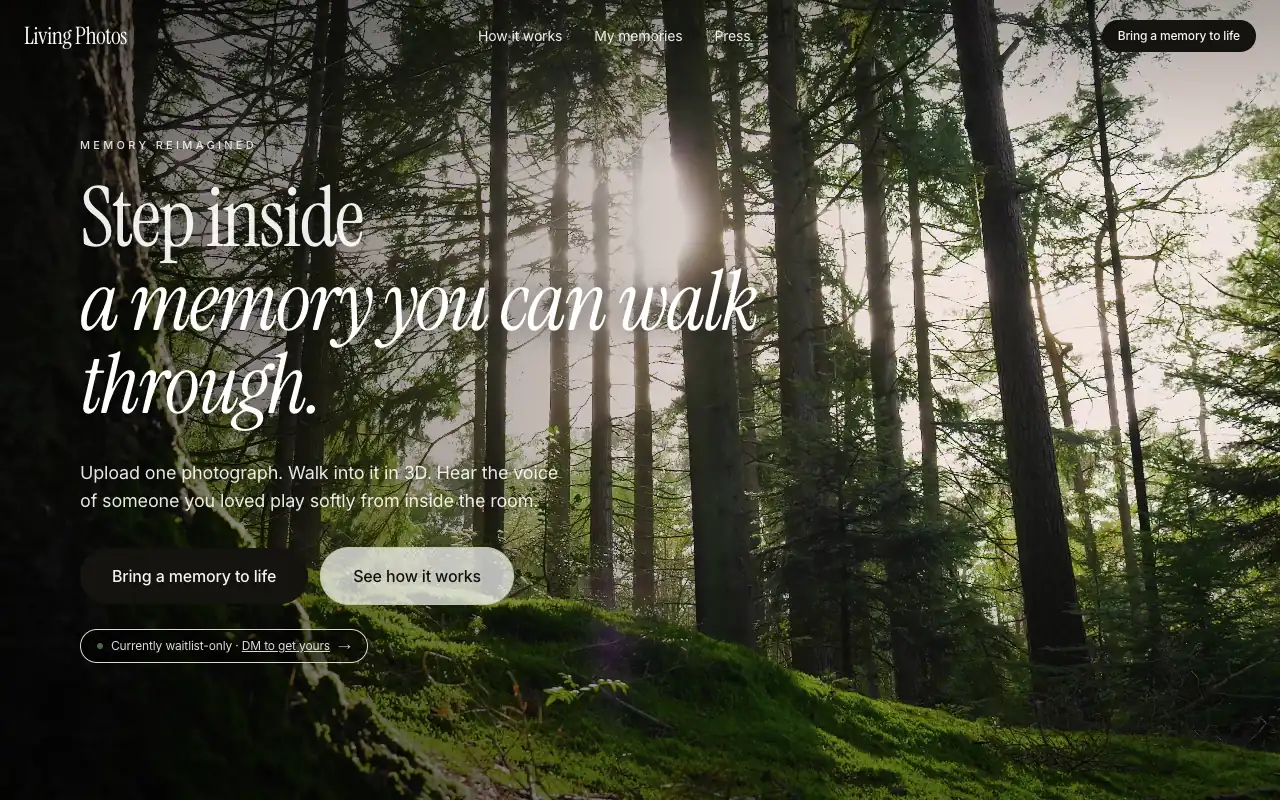
Living Photos is a web app that turns one interior photograph into a walkable 3D Gaussian-splat scene with a consent-cloned voice speaking inside it, built by Anirudh Vasudevan for ElevenHacks 2026, the Stripe and ElevenLabs hackathon, in May 2026. You upload a photo. A few minutes later you get a URL where you walk the room with WASD, look by dragging, and hear a voice you chose speak from inside the scene.
The hard part was chaining four paid services (World Labs Marble, FAL Hunyuan3D, ElevenLabs, Stripe) into one pipeline that still ran end to end on my laptop with zero keys.
Why I went mock-first instead of wiring the real APIs on day one
The obvious hackathon approach is to grab every API key, call each service from a route handler, and hope the demo holds. But a real Marble world takes four to five minutes to generate, and Hunyuan3D meshes take up to a minute each. Every failed run costs money and minutes, and .planning/PROJECT.md budgeted about three days of build time.
So the first thing I built in Living Photos was lib/ai/types.ts: TypeScript interfaces for every paid upstream, MarbleAdapter, MeshAdapter, SfxAdapter, VoiceAdapter, StripeAdapter, and BlobAdapter. Each has a Mock* and a Real* class in lib/ai/, and lib/ai/factory.ts picks the set from env.MOCK_MODE.
The other ways I could have done it were a feature flag per call site, which spreads if (mock) across every route, or recorded HTTP responses, which still need a real run per code path. Interfaces plus a factory gave me one swap point, and the whole loop ran before I spent a dollar on generation.
What Living Photos does, step by step
From the user's side, Living Photos is three screens after the landing page.
On /create, you drop a photo into a react-dropzone area. The client uploads it straight to storage through a signed URL, then POSTs the public URL to /api/scenes, which creates the scene and starts generation.
On /voice, optionally, you name the person whose voice you are cloning and read a server-issued consent phrase aloud; the server clones the voice only after its checks pass. A quick-start dropdown offers pre-consented ElevenLabs library voices instead.
On /scene/<slug>, the page polls status while the pipeline runs. When the scene is ready you see a $15 unlock button (DEFAULT_CENTS = 1500 in lib/pricing.ts) that opens Stripe Checkout. After payment, the viewer loads the splat, ambient audio, and narration.
Architecture
Living Photos is a Next.js 15 App Router app on Vercel. Route handlers under app/api/ call small service modules (lib/scenes.ts, lib/payments.ts, lib/voice/consent.ts), which call the adapter bag from lib/ai/factory.ts. Generation runs in an Inngest step function, or, without an Inngest key, in an inline local pipeline using the same adapters.
Left to right: the browser uploads to blob storage, /api/scenes emits scene/uploaded, and the pipeline walks Marble, Hunyuan3D, and ElevenLabs before publishing the scene as ready. Payment is a separate path through /api/stripe/checkout and the Stripe webhook; the viewer only receives asset URLs once paid is true.
The main choices in the code:
| Layer | Choice | Why |
|---|---|---|
| Framework | Next.js 15 App Router, React 19, strict TypeScript | Route handlers, RSC, and Vercel deploy in one repo |
| Paid upstreams | Interface plus Mock/Real adapters in lib/ai/ | Full loop runs with zero keys; contract tests cover both |
| Background jobs | Inngest 3 step function with retries: 3 | Real runs take 4 to 5 minutes, past serverless timeouts |
| Local fallback | Patched Inngest.prototype.send in lib/inngest/client.ts | Same event and adapters, no cloud account needed |
| Splat rendering | Spark.js v2 inside React Three Fiber 9 | Spark decodes .spz in a WASM worker and sorts splats per frame |
| Movement | Drei CameraControls driven by forward() and truck() | CameraControls overwrites camera.position each frame |
| Payments | Stripe Checkout plus raw-body webhook verification | One-time $15 unlock; no card data touches my server |
| Idempotency | (provider, event_id) key checked before any mutation | Stripe retries webhooks; fulfillment must happen once |
| Persistence | globalThis.__livingPhotosStore in-memory maps | RSC and route handlers need one shared instance |
How it works
The adapter factory refuses to run mocks in production
The mock Stripe adapter verifies webhooks with an HMAC secret that is a committed constant. In production that would turn the paywall into a door anyone could open by signing their own event, so build() throws if MOCK_MODE is true under NODE_ENV=production. STRIPE_FORCE_REAL lets me test real Stripe Checkout while the expensive upstreams stay mocked.
// lib/ai/factory.ts
  if (env.MOCK_MODE) {
    if (env.NODE_ENV === "production") {
      throw new Error(
        "MOCK_MODE=true is not permitted when NODE_ENV=production. " +
          "Set MOCK_MODE=false and provide real API keys before deploying.",
      );
    }
    const stripeAdapter = env.STRIPE_FORCE_REAL
      ? new RealStripeAdapter(env.STRIPE_SECRET_KEY, env.STRIPE_WEBHOOK_SECRET)
      : new MockStripeAdapter();
The contract tests in tests/contract/ make the swap trustworthy. The upstream adapter suites (Marble, mesh, SFX, voice, avatar) build { name, build } pairs; the mock always builds, the real one returns null unless its key (say WORLD_LABS_API_KEY) is set, and the suite calls it.skip naming the variable.
One event, two runtimes
lib/inngest/functions/scene-generate.ts is the heart of Living Photos: an Inngest function with seven step.run calls, submit-marble, wait-marble, detect-objects, one mesh-<objectId> per object fanned out with Promise.all, generate-sfx, an optional generate-narration, and publish. Each step is memoized, so a crash after Marble finishes does not resubmit it.
The trick is in lib/inngest/client.ts. When MOCK_MODE is on, or there is no INNGEST_EVENT_KEY, I replace send on the Inngest prototype. The override records the event for tests and fires the local pipeline without awaiting it, so POST /api/scenes returns in milliseconds.
// lib/inngest/client.ts
  proto.send = async (
    args: { name: string; data: unknown } | Array<{ name: string; data: unknown }>,
  ) => {
    const list = Array.isArray(args) ? args : [args];
    for (const e of list) {
      sentEvents.push({ name: e.name, data: e.data });
      if (e.name === "scene/uploaded") {
        const data = e.data as { sceneId: string; photoUrl: string };
        import("./mock-pipeline")
          .then((m) => m.runMockScenePipeline(data.sceneId, data.photoUrl))
lib/inngest/mock-pipeline.ts runs the same sequence with a capped pollUntilDone helper. It also does something ugly that saved money: after submitting to Marble it writes marble:job:<id> into the scene's error column, so a dev-server restart resumes polling instead of paying for a second world.
Rendering a Gaussian splat inside React Three Fiber
Marble returns a .spz file, a compressed Gaussian splat. lib/image-blaster/marble.ts POSTs to worlds:generate, polls operations/{id}, and pickSpzUrls picks a full-res URL for desktop and a 100k or 50k variant for phones, because heavy worlds crash Safari's WebGL.
The declarative way, extend() plus a JSX element, created the SplatMesh but never fired its async WASM decode: black canvas, no .spz request. The vanilla Three pattern from Spark's README worked, so I replicated it inside a useEffect.
// components/viewer/splat-renderer.tsx
sparkRenderer = new SparkRenderer({ renderer: gl });
scene.add(sparkRenderer);

mesh = new SplatMesh({ url });
mesh.raycast = () => {};
if (flipY) {
  mesh.rotation.x = Math.PI;
}
scene.add(mesh);
SparkRenderer and SplatMesh are siblings, not parent and child, because the renderer drives sorting and decode for every splat. rotation.x = Math.PI flips Marble's Y-down convention to Three's Y-up. And React 19 Strict Mode mounts, unmounts, and mounts again; the first cleanup disposed a half-decoded mesh and crashed the worker, so disposal now waits on mesh.initialized.
Spark's worker also needs SharedArrayBuffer, which browsers expose only on cross-origin isolated pages, so next.config.ts sets Cross-Origin-Opener-Policy: same-origin and Cross-Origin-Embedder-Policy: credentialless on /scene/* only. Applied site-wide, they would break Stripe Checkout's cross-origin scripts.
WASD lives in components/viewer/wasd-controls.tsx, a requestAnimationFrame loop calling controls.forward() and controls.truck() on the Drei CameraControls ref, because CameraControls ignores direct writes to camera.position.
Stripe fulfillment with an idempotency floor
app/api/webhooks/stripe/route.ts runs on the Node runtime, reads req.text() for the raw body, and hands it with the stripe-signature header to adapters().stripe.verifyAndParseWebhook. The real adapter calls stripe.webhooks.constructEvent. The mock reimplements Stripe's t=...,v1=... scheme with crypto.createHmac and crypto.timingSafeEqual, so tests exercise the verify path offline. After verification, lib/payments.ts marks the event processed before touching anything else.
// lib/payments.ts
const first = memProcessed.markProcessed({
  id: newId("proc"),
  provider: "stripe",
  eventId: evt.id,
  eventType: evt.type,
  payload: evt,
  processedAt: new Date(),
});
if (!first) return { mutated: false, reason: "duplicate" };
Duplicates return { mutated: false } with a 200 so Stripe stops retrying. Only the first sighting calls markScenePaid and sends a best-effort Resend email.
The voice consent gate
lib/voice/consent.ts is the part I am most careful about. buildConsentDraft(name) generates a six-character nonce from a confusable-free alphabet and embeds it in a phrase the user reads aloud. createConsentedVoiceClone runs three checks before any ElevenLabs call: the name is not on a public-figure denylist (NFKD-normalized, diacritics stripped, matched as a token subsequence), and both the nonce and the name appear in the transcript. Only then does it call adapters().voice.cloneVoice and write a voice_clones row with consent_verified_at. POST /api/scenes closes the loop: a supplied voiceCloneId must map to a consented, non-revoked clone.
The hard parts and the shortcuts
The consent transcript is client-trusted in this build. A comment in app/voice/voice-client.tsx says that in real mode this would be an ElevenLabs Scribe transcript; for the demo it sends the draft phrase back as the transcript. The server-side checks are real; their input is not yet.
Postgres is provisioned but unused. lib/db/schema.ts, the migration in drizzle/, and a lazy Neon client all exist, but every service reads and writes lib/db/memory.ts, pinned to globalThis so server components and route handlers share one instance. A cold start wipes state.
detect-objects is a stub returning two fixture objects, a lamp and a chair, so every scene meshes the same two crops. The real SFX adapter returns the MP3 as a base64 data URL instead of piping it through the blob adapter. There is no auth, so anyone with a consented voice id could narrate their own scene in that voice (there is a TODO(auth) in the code). The README still lists GitHub Actions CI, but the repo has no .github directory, so the only gate is the pre-push hook that scripts/hooks/pre-push installs.
The Marble, FAL, and ElevenLabs HTTP clients in lib/image-blaster/ started as a port of the MIT-licensed image-blaster project by neilsonnn, which .planning/PROJECT.md records as the foundation. The adapters, pipeline, consent gate, payments, and viewer are mine.
What shipped
Living Photos won ElevenHacks 2026, the Stripe and ElevenLabs hackathon. On the live site, generation is gated behind a waitlist (ALLOW_GENERATION = false in app/create/create-client.tsx) so drive-by uploads do not burn API credits.
Per the README, the test suite is 122 passing and 5 skipped, the skipped slots being real-adapter contracts waiting on keys.
What I would do differently
Wire Scribe, so the consent gate checks real speech instead of the phrase we asked for.
Swap the memory store for Drizzle behind the same service functions. Add auth so voice clones are scoped to their owner. Use Marble's collider_mesh_url to stop the camera walking through walls. Replace the error column squat with a marbleJobId column and an Inngest step.waitForEvent on a Marble webhook instead of polling.
Key takeaways
- Put every paid upstream behind an interface with a mock and a real implementation, then write one contract test that loops over both.
- Refuse mock mode in production at the factory, not in documentation. A committed HMAC secret plus one missing env var is an open paywall.
- If a library's async initialization is driven by its own render loop, a declarative wrapper may construct the object and never start it. Use the vendor's imperative example inside a
useEffect. - Under React Strict Mode, defer disposal of anything that decodes asynchronously until its ready promise resolves.
- Record a webhook event as processed before you mutate anything, keyed on
(provider, event_id), and return 200 for duplicates.
FAQ
How does Living Photos turn a photo into a 3D scene?
Living Photos sends the uploaded photo URL to World Labs Marble 1.1 through a raw fetch in lib/image-blaster/marble.ts, polls the operation until done, and pulls a .spz Gaussian-splat URL from the response. An Inngest step function then meshes objects with FAL Hunyuan3D, adds ambient sound from ElevenLabs, and publishes the scene.
How does Living Photos render Gaussian splats in the browser?
Living Photos uses Spark.js v2 inside a React Three Fiber canvas. The SplatRenderer component creates a SparkRenderer and a SplatMesh imperatively in a useEffect, adds them as siblings, and rotates the mesh 180 degrees on X to convert Marble's Y-down output to Three's Y-up.
How does Living Photos prevent voice cloning without consent?
Living Photos issues a six-character nonce inside a consent phrase, requires the user to read it aloud, and checks server-side that the nonce and the person's name appear in the transcript and that the name is not on a public-figure denylist. Only then does it call ElevenLabs Instant Voice Cloning. Today the transcript comes from the client; speech-to-text is the planned fix.
How does Living Photos handle Stripe webhook retries?
Living Photos verifies the raw webhook body against the stripe-signature header, then records the event under a (provider, event_id) key before any state change. If the key already exists, the handler returns 200 with mutated: false and does nothing. Only the first delivery of checkout.session.completed marks the scene paid.
Can Living Photos run without any API keys?
Yes. With MOCK_MODE=true, every adapter in lib/ai/ returns deterministic fixture data, the Inngest client runs the pipeline inline, blob storage is an in-memory map, and Stripe webhooks are signed with a mock HMAC scheme.
Links
- Live demo: living-photos-rust.vercel.app
- Source (source-available, for review): github.com/anirxdh/Living-Photos