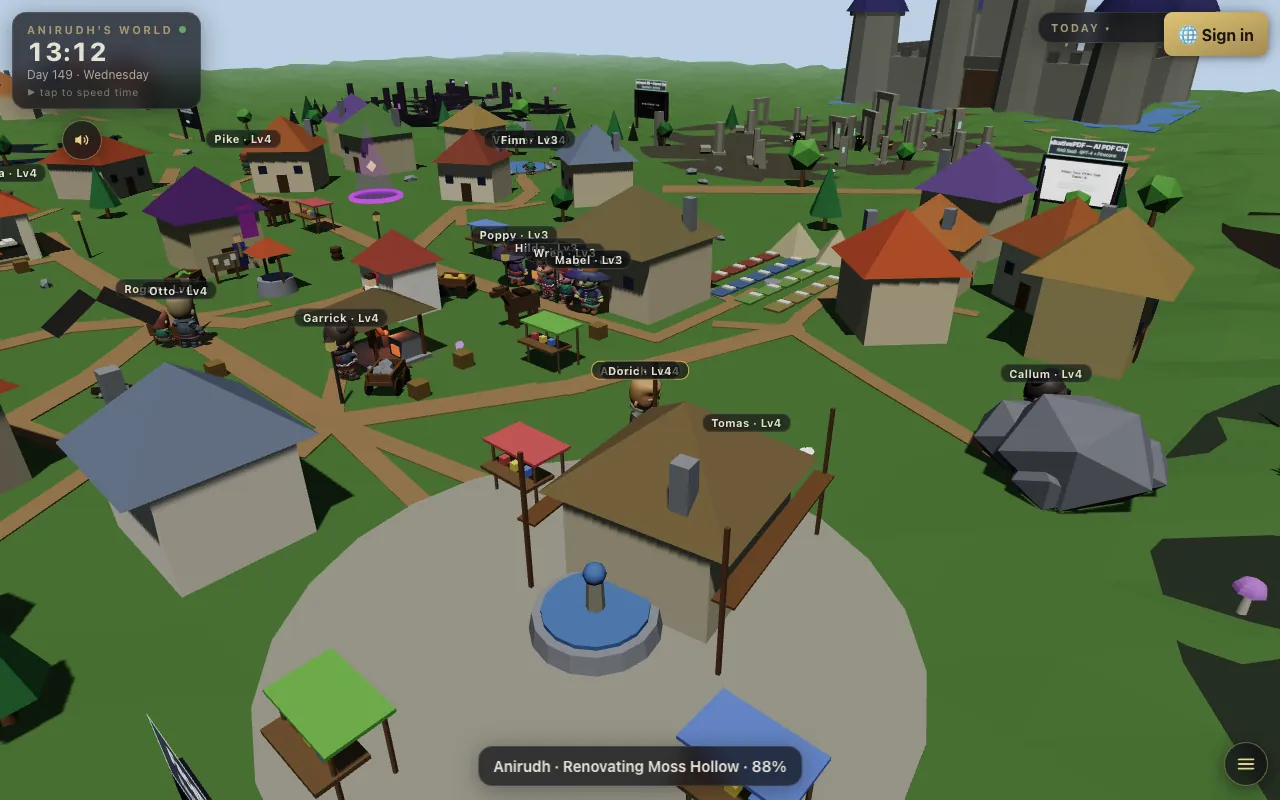
The village that kept going while I slept
The first build of this village went live on June 11, 2026 (the date is logged in docs/HANDOFF.md). Close the tab at night and open the URL the next morning, and the chief is somewhere else, with the build percentage in the label over his head higher than when you left. Nothing ran overnight to make that happen. No cron job, no database write, no server tick. The village was simply evaluated at a new time.
Anirudh's World (the codebase is called Vivarium) is a browser-based 3D life simulation that keeps a low-poly village of 20 villagers living on the real-world clock with no backend, built by Anirudh Vasudevan as a personal project and as the playable "Explore" world linked from this portfolio. Every frame, the browser computes the entire shared world as a pure function of two inputs: a fixed seed string and Date.now(). There is no save file and no simulation loop. That one decision is the whole project.
It is plain ES-module JavaScript on three.js r184 with no bundler. The source is private; the world is live at av-world.replit.app.
Why a pure function instead of a server tick
Before writing code I looked at the two systems everyone points to for "living NPC" worlds, and both stop when you look away. Stanford's Generative Agents advances only when an operator issues a step. a16z's AI Town runs a Convex server tick that a cron job halts after five minutes with no viewers. My notes in RESEARCH.md are blunt about it: no process to keep alive, no state to persist, no server to pay for.
The obvious approach was a server that ticks the village and persists state. The version of that which RESEARCH.md actually costed out is AI Town's engine pattern on Convex or Cloudflare Durable Objects, and the notes park it as a later option, only if live interactivity is ever wanted. I chose to make the world a pure function F(WORLD_SEED, now). A visitor returning after three weeks needs no catch-up; re-evaluating F(now) is the catch-up. Every viewer at the same instant sees the same village, and nothing can pause.
The constraint was cost: a shared world I could leave alone for a year on a free static host. The Vercel mirror is exactly that. The only paid piece, the Replit VM, exists for the optional multiplayer server, not for the village. The trade is that the shared world cannot react to anyone, so anything interactive lives in a strictly local layer on top.
What Anirudh's World does, from the visitor's side
You open the page and the village is already mid-day, or mid-night, depending on when you arrive. A HUD shows the village clock (fixed PST offset, same hour for every viewer), the weekday, and an event ticker. Twenty villagers go about their day: a chief with a golden crown who is a mini version of me, a woodcutter, a herbalist, a scout, a night watch, and fifteen townsfolk who arrive over the first seven weeks.
Some nights wolves come and the defenders line up at the gate. Some days the hunters go out. Houses go up on twelve lots over multi-day builds. Add #t=2026-07-01T09:00:00Z to the URL and you see the world at that instant, past or future, from the same evaluate() call.
Sign in and you can forge a hero, fight monster camps and take guild quests. Seven camps are the Builder's Trials, each guarding a portal to one of my real projects.
Architecture
Anirudh's World is split into a deterministic spine that must never change by accident, a simulation core that consumes it, a renderer that only draws, and a local play layer on top. For the shared village the only outside runtime dependencies are three.js and drand; sign-in pulls Clerk from esm.sh.
js/config.js holds the frozen constants, js/prng.js turns names into random streams, js/clock.js turns a timestamp into a logical day and time-of-day, and js/fate.js fetches beacon values. js/sim.js combines them in evaluate(nowMs), which returns every villager's position, pose, label and needs plus every lot, garden plot and animal. js/main.js calls that once per frame and hands the result to renderer modules that only draw. server/server.mjs serves the files on Replit; login-sync and presence stay off unless CLERK_SECRET_KEY is set on the VM.
The choices that define the system:
| Layer | Choice | Why |
|---|---|---|
| World time | Epoch-ms integer math, fixed PST offset, day rolls at 04:00 | No local Date methods, no DST, same for every viewer |
| Randomness | Vendored splitmix32, sfc32, xmur3, cyrb128, squirrel3 with golden vectors | Named streams per decision; drift fails selfTest() at boot |
| Unpredictability | drand beacon value at each day's 04:00 boundary, from day 18 on | Future rounds do not exist yet; past rounds last forever |
| Movement | Hand-authored road graph, Dijkstra, arc-length paths | Position at any instant is a binary search |
| Verification | scripts/snapshot.mjs FNV-1a digest, must equal 8dfc5c74 | One number says whether the live world changed |
| Collisions | core/solids.js imported by player movement and the audit | Game and audit cannot disagree |
| Rendering | three.js r184 via jsDelivr import map, no bundler, no service worker | Plain files deploy anywhere |
How it works
Named random streams instead of one RNG
The first rule in js/sim.js is that day N never depends on day N-1's random outcome. If it did, evaluating day 400 would mean replaying 399 days of draws. So no single RNG advances. Every decision draws from its own stream, named by what it is for.
// js/prng.js
export function seed32(day, id, purpose) {
  return xmur3(`${WORLD_SEED}|${day}|${id}|${purpose}`)();
}

// One draw in [0,1) for a named decision.
export function roll(day, id, purpose) {
  return splitmix32(seed32(day, id, purpose))();
}
A wolf night is fRoll(day, 'world', 'wolves') < 0.26 (after a day >= 2 guard). The purpose strings are a frozen API, because changing one silently retcons the past for every viewer. At boot, main.js fetches the source of sim.js, prng.js, clock.js and config.js and logs a console error if any contains Math.random.
The fate layer: borrowing entropy from drand
A world that is a pure function of a seed has a problem: the author can read the future. I could evaluate day 1000 and know which nights the wolves come. The fix in js/fate.js salts each day's streams with a value that does not exist until that day arrives.
drand is a public randomness beacon run by the League of Entropy that publishes a new signed value every 30 seconds. Each village day's fate is the beacon round at that day's 04:00 boundary. roundForDay(day) computes the round from the chain's genesis timestamp and period, fetchRound() asks api.drand.sh (with a Cloudflare mirror as fallback) for /public/<round>, and the sim reads it synchronously.
// js/fate.js
export function fateOf(day) {
  if (day < FATE_START_DAY) return { hex: 'era1', real: true };
  if (testProvider) return { hex: testProvider(day), real: true };
  const hex = mem.get(day);
  if (hex) return { hex, real: true };
  return { hex: pseudoHex(day), real: false };
}
Inside sim.js, fRoll() wraps the stream seeding: for days 0 through 17 it falls back to roll(), because those days predate the layer and stay seed-only as frozen history. From day 18 on it prefixes the stream name with fate:${hex}, real or pseudo. For a day whose round is not yet published, pseudoHex() returns a deterministic stand-in flagged real: false, and the HUD says so. When the clock crosses 04:00, refreshFates() in main.js fetches the real round and the preview is replaced. The world is reproducible backward and unknown forward, with no mutable server state.
One frame, start to finish
main.js calls simNow() from clock.js, which is Date.now() unless a debug hash is set. evaluate(nowMs) calls worldClock(nowMs), which subtracts WORLD_EPOCH and the 04:00 rollover to get a logical day and a tod in milliseconds. dayKind(day) rolls the fated streams for wolves, hunts and festivals.
For each villager, buildPlan(day, npcId) runs an archetype script (or a generic script parameterised by one of 15 professions) that pushes walk and at segments from time 0 to DAY_MS. Plans are cached with the day's fate hex in the key, so a newly arrived real fate invalidates the preview. findSegment() binary-searches the plan for the segment covering tod. For a walk, positionAt(path, WALK_SPEED, tod - seg.t0) binary-searches the path's cumulative arc lengths and interpolates. Position is a lookup, not an integration.
needsAt() then sums hunger, energy, fun and social decay across the segments lived so far, scaled by trait multipliers from data/cast.js. Those needs feed a Sims-style argmax that picks where to eat, and the winning reason ends up in the villager's label.
The verification scripts that make refactors safe
Since every viewer sees F(now), a stray refactor that changes one draw changes the live world for everyone, past and present. So before every commit I run three scripts in scripts/.
snapshot.mjs is the golden-master test. It evaluates the world on 23 chosen days, sampled every 17 minutes, and streams every villager's position, pose, label, level and needs, plus every animal, lot and garden plot, into one FNV-1a hash.
// scripts/snapshot.mjs
let h = 0x811c9dc5 >>> 0;
function feed(str) {
  for (let i = 0; i < str.length; i++) {
    h ^= str.charCodeAt(i);
    h = Math.imul(h, 0x01000193) >>> 0;
  }
}
const q = (n, p = 100) => Math.round(n * p) / p;   // quantize floats (sub-pixel noise is harmless)
The digest must equal 8dfc5c74. If it drifts, the world changed, and I either revert or day-gate the change so it applies only from a future day.
check-collisions.mjs sweeps 15 days at one to 30 second resolution and asserts no villager ever intersects a solid: 12,906,000 positions on the current cast. The geometry comes from core/solids.js, the module the player's movement also imports, so the game and the audit cannot drift apart. The first run, logged in docs/qa/evidence.md, found 43,239 hits. check-activities.mjs reads clip names out of each GLB and proves every authored pose is reachable.
Camps that guard portals to real projects
The Builder's Trials are why this is my portfolio's Explore page rather than a toy. data/projects.js defines seven camps, each with a monster type, stats and a project block holding a title, a URL and a screenshot. They sit in the same CAMPS list as every other camp, so spawning and loot need no extra code. js/projectcamps.js adds a screenshot billboard and a portal that stays invisible until the camp is cleared:
// js/projectcamps.js
          if (total > 0 && alive === 0) {
            s.unlocked = true;
            save[s.camp.id] = true;
            persist();
            s.portal.visible = true;
            floatText(s.px, s.pz + 1, 'Portal revealed!', '#7dffc0');
            floatText(s.px, s.pz - 0.4, s.camp.project.title, '#b9ffdd');
          }
Unlocks persist in localStorage. Stepping within 2.2 units of an open portal calls window.open on the project URL. The camps guard LARK, Apartment 4B, Living Photos, FaceTime from Mars, ScreenSense, TalkativePDF and CIVS.
The hard parts
The frozen-identifier rule bit me most often. Once the world is live, WORLD_SEED, WORLD_EPOCH, the PRNG source text, every purpose string and every villager id are append-only. I could not fix an awkward day 5 schedule without changing day 5 for everyone who time-travels there. So every behaviour change is gated on a day index, and the golden digest is how I trust that discipline.
The 04:00 boundary has a small race. refreshFates() runs every 120 seconds, so for up to two minutes after a new round lands a viewer may still see the pseudo-fate preview, and a villager can visibly change plans at the swap.
Some things are hacky. The Math.random guard is a regex over fetched source text, not a linter. The geography still lives inside sim.js because it is tangled with the road graph. js/player.js is a 1,750-line file that should be six modules. And the shared world does not know you exist: clearing every camp changes nothing for the villagers.
Results
Anirudh's World is live at av-world.replit.app as a single Node process on a Replit Reserved VM that serves the game files and runs the optional multiplayer server on the same origin; that server only runs presence when the Clerk secret is set on the VM. A static mirror on Vercel serves the same village with no server at all. There is no award; this was not a hackathon project. The repo has 20 villagers, 15 professions, seven project camps, and roughly 10,000 lines of hand-written ES modules. All three verification scripts pass on the current build, with digest 8dfc5c74.
What I would do differently, and what is next
I would move the geography into data/geography.js on day one, before the road graph grew around it, and split player.js behind an interactables registry earlier. js/fate.js trusts the JSON drand returns: it reads the randomness field and only hashes the signature field as a fallback, never verifying it. I would verify the signature client-side. One of the v2 hooks listed in docs/HANDOFF.md is weather, seeded by a hash of the week rather than the beacon. Letting fate decide more than wolves and hunts is an idea, not a plan.
Key takeaways
- If state is a pure function of time, catch-up logic disappears. Re-evaluating at the new time is the catch-up.
- Give every random decision its own named, seeded stream. A single advancing RNG turns every refactor into a retcon.
- A public randomness beacon like drand gives a deterministic system an unwritten future and a reproducible past, with no server.
- Hash the whole world across a grid of timestamps into one digest and gate every commit on it.
- Import collision geometry from one module in both the game and the offline audit, so they cannot disagree.
- Store walks as arc-length paths so position at any instant is a binary search. Integration drifts; lookup does not.
FAQ
How does Anirudh's World keep running with no server?
Anirudh's World never runs in the usual sense. The village is a pure function of a fixed seed string and wall-clock time, implemented as evaluate(nowMs) in js/sim.js. The browser calls it every frame with Date.now() and draws the result. Nothing is stored and nothing ticks, so there is no process to keep alive.
How does Anirudh's World make the future unpredictable if it is deterministic?
From day 18 onward, js/fate.js salts each day's random streams with the drand beacon value at that day's 04:00 boundary. Future rounds do not exist until their time arrives, so nobody, including the author, can evaluate tomorrow's real wolves. For unpublished days, Anirudh's World shows a deterministic preview flagged as not real.
How does Anirudh's World test that a code change did not alter the world?
scripts/snapshot.mjs evaluates the village on 23 days at 17-minute intervals and hashes every villager, animal, lot and garden plot into one FNV-1a digest that must stay 8dfc5c74. A second script sweeps 12.9 million villager positions against core/solids.js, and a third proves every animation clip is reachable.
Links
- Live world: av-world.replit.app
- Source: private repository