The chatbot that talked to the wrong person
RUA is a caregiver command center that keeps medications, refill runways, records, emergency sheets, and insurance paperwork for several older adults in one place, built by Anirudh Vasudevan for the HHS ACL Caregiver AI Prize Challenge (Track 1). It is built as a local-first iOS app, which had not reached TestFlight as of its last commit, with a web mockup and a waitlist site beside it. It did not start there. It started as a chat box for the elder.
The first version was a Flask and React app called Elderly Care Agent, public as anirxdh/AiCaretaker, a repo that dates to 2025. An older adult typed or spoke into one chat box, a LangChain agent answered, and when a message sounded like chest pain the agent asked whether to call 911. It had two users, John and Mary, hard-coded as buttons in frontend/src/App.js.
What I got wrong was who I was building for. The person who opens a health app every day is not the older adult. It is the daughter who is also watching her mother and an aunt, and who has to track every fill date herself. When the challenge opened with a July 31, 2026 deadline, I went back to the same problem with a different user. This is the product story across five repos; the native app's engineering lives in the offline-first RUA article.
Why the caregiver became the unit of design
The obvious move was to extend AiCaretaker with accounts and a dashboard. But backend/agent.py is 811 lines of prompt and glue around ChatOpenAI(model="gpt-4o-mini"), and its emergency path prints "Calling 911..." to the terminal. Nothing in it was load-bearing for a caregiver.
The second option was the one I wrote up first. In a private workspace I drafted a concept paper and a PII privacy architecture with a rule at the top: if a claim cannot be proven with a diagram, an audit log, or a test, RUA does not make it. "HIPAA-protected" went on the prohibited side of its claims register. That RUA was server-first: a server database with row-level security keyed to the care relationship, and zero-retention AI endpoints. The proposal argued against hourly AI scans, which it calls costly, non-reproducible, and regulatorily unsafe, and for event-driven rules instead.
The deadline decided everything. Phase 1 of the challenge is a design phase, not a product phase. So I split the work: an HTML mockup I could screenshot for the report in days, then a native app that proved the deterministic core was real. And I dropped the server for v1. A direct-to-consumer caregiver app is almost certainly not a HIPAA covered entity (the FTC Health Breach Notification Rule still applies), and the honest way to protect someone else's health data on a short timeline is to never hold it. Row-level security became a SQLCipher database on the phone with the key in the Keychain.
What RUA does, from the caregiver's seat
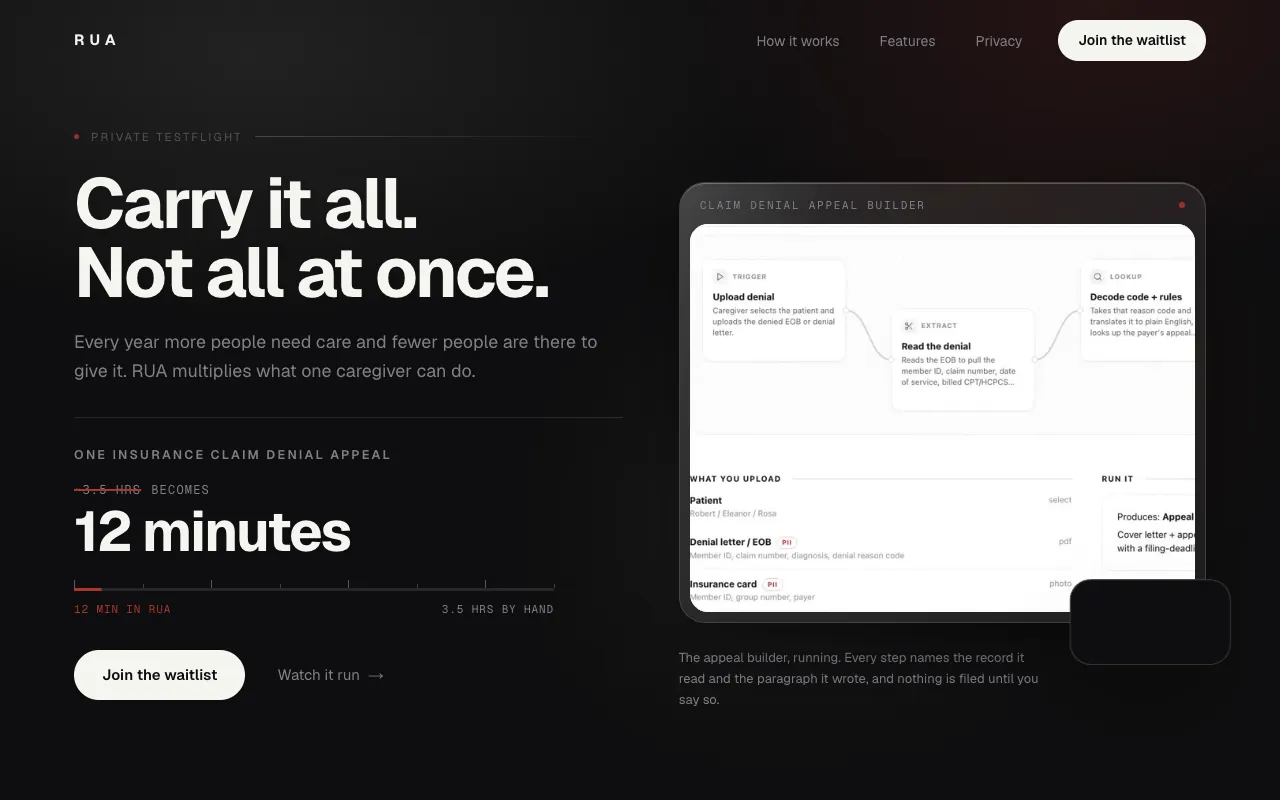
RUA opens to a Today's Digest. The demo family is Maria caring for her dad Robert, her mom Eleanor, and her aunt Rosa, and the digest shows one lead item: Robert's metformin runs out in a few days. Everyone is fictional, and the app says so. Each person has a Patient 360 with an allergy banner that stays visible on every tab, vitals, medications with runway bars, labs, and documents. Scan a label parses a pill label into fields Maria confirms one by one; today the native app does this from a bundled sample label, with manual entry as the fallback, and the Apple Vision module is spiked but not yet packaged. The ER sheet prints to PDF, and six emergency guides work with no signal. The Handoff Pack for a respite caregiver exists only in the mockup so far. Six admin workflows, from claim denial appeals to Medicaid renewal, run as node graphs that pause at a human confirm step before any document is produced.
Architecture
RUA is three built surfaces plus one private set of documents. The mockup in hearth-app is built around one index.html with a hash router and inline data, plus guides.html for the emergency guide book and variants.html, a gallery of the design iterations. The native app in hearth-native is a pnpm monorepo where Expo screens read from an encrypted SQLite database and a pure TypeScript core owns every safety-relevant number. The waitlist site in rua-site is a Next.js app on Netlify with one API route.
Reading left to right: AiCaretaker's single-user chat is what the caregiver pivot replaced, the proposal sets the claims RUA may make, and the mockup's screens became Figures 1 to 9 of the conference report, as a note in the variants.html gallery records. I then used the mockup as the spec for the native app. I rebuilt its look as the native design tokens in apps/mobile/src/ds, and I rewrote its six WFDATA workflows as the six versioned templates in packages/workflows. Nothing flows from the app to a server, because in phases 1 to 28 there is no server; the roadmap's phases 29 and 30 add opt-in accounts and sync. The waitlist site is separate from the app and holds only what the signup form sends: an email, two optional answers, and a timestamp (plus the browser's user-agent string, cut to 200 characters).
Each layer kept the smallest tool that could do its job.
| Layer | Choice | Why |
|---|---|---|
| Design docs | Markdown proposal, PII architecture, claims register (private) | Every privacy claim must be provable before it appears in UI copy |
| Mockup | index.html plus guides.html, hash router, inline WFDATA and TPDATA | Screenshots in days; fake data next to the renderer |
| Native store | SQLCipher SQLite, key in Keychain, Drizzle migrations | Replaces the proposal's server RLS with encryption at rest on device |
| Native logic | packages/core pure TypeScript, no React, today injected | Runway and digest are pure functions with golden tests and never read the clock |
| Site framework | Next.js 16 on Netlify, @netlify/plugin-nextjs pinned | One API route needs a runtime; pinning stops a static fallback |
| Signup storage | Netlify Blobs store rua-waitlist, strong consistency | Durable, no extra account, survives redeploys |
| Notifications | Netlify Forms replay plus optional webhook, best effort | Email without an API key; a flaky notifier can never lose a signup |
How it works
From one elder's chat to a caregiver roster
AiCaretaker's chat route took a message and a user id and returned a string.
# AiCaretaker/backend/app.py
@app.route('/chat', methods=['POST'])
def chat():
    try:
        data = request.get_json()
        user_input = data.get("message")
        user_id = data.get("user_id")
        response = agent_response(user_input, user_id=user_id)
        return jsonify({"response": response})
    except Exception as e:
        # ...
        return jsonify({"error": str(e)}), 500
That user_id is the seed of RUA. Once one caregiver needs to see both John and Mary, the design flips: the roster is the home screen, the person is a tab, and the question the app answers is "who, out of everyone I care for, needs me right now?"
The HTML mockup as the executable spec
I built hearth-app in one afternoon of commits on July 11, 2026, and its README is blunt: no backend, no build step, fake data. Its main file has 14 views and about 350 lines of script, toggled by a seven-line router that also syncs the sidebar and the URL hash.
// hearth-app/index.html
function go(v){
  document.querySelectorAll('.view').forEach(x=>x.classList.remove('on'));
  var el=document.getElementById('v-'+v); if(el) el.classList.add('on');
  document.querySelectorAll('.nav').forEach(n=>n.classList.toggle('on', n.dataset.v===v));
  document.querySelector('main').scrollTop=0;
  if(history.replaceState) history.replaceState(null,'','#'+v);
}
The parts that mattered were the inline data objects. WFDATA holds the six admin workflows as typed nodes, with 21 of its 31 inputs flagged pii: true. buildFlow() draws them over an SVG layer of bezier edges, and runWf() steps each node through active and done states every 820 milliseconds. It looks like a workflow engine. It is a slideshow. But writing every workflow down as data, with a review node before the output node, made the six native templates a rewrite of known workflows instead of a fresh design exercise, each with its human review step already in place.
Local-first flips the privacy plan
The native app started a day after the mockup. Its architecture document says a pure TypeScript core computes everything that must be exact, an encrypted SQLite database is the single source of truth, and there is no server, no account, and no AI in the first eight phases. The most important number in the product is refill runway.
// hearth-native/packages/core/src/runway.ts
/**
 * Compute the runway for the most recent fill.
 * Returns null for PRN/as-needed meds (no forecast is honest forecasting).
 */
export function computeRunway(fill: FillInput, today: LocalDate): Runway {
  // ...
  const runOutDate = addDays(fill.fillDate, fill.daySupply);
  const daysRemaining = daysBetween(today, runOutDate);
Fill date plus day supply, compared against a today the caller passes in, never read from a clock. It has golden tests across DST and leap days. Everything the proposal pushed to a server, the app pulled onto the phone: row-level security became SQLCipher, the server audit log became change_log and access_log tables, zero-retention OCR became an on-device Apple Vision seam. The same honesty rule shows up in the guides: every emergency guide carries a "Pending clinician review" line on content version 0.9 instead of the word "clinician-reviewed" that the mockup used.
The waitlist that shows its receipt
rua-site is a Next.js 16 page with one form and the only real server request in the product. Waitlist.tsx asks for an email, reveals two optional selects once it matches a regex, and renders a ledger titled "What this page sends," with the email masked from the third character.
The API route holds the one fix worth telling. An earlier version treated a configured webhook as the system of record, so a slow third party could lose a signup. The current route stores first and notifies second.
// rua-site/src/app/api/waitlist/route.ts (private repo)
async function persist(entry: Signup): Promise<Via> {
  try {
    const { getStore } = await import("@netlify/blobs");
    const store = getStore({ name: STORE, consistency: "strong" });
    await store.setJSON(`${entry.at}__${encodeURIComponent(entry.email)}`, entry);
    return "blobs";
  } catch { /* not running on Netlify, or blobs unavailable */ }
  // ...
  return "file";
}
The elided lines append to a local .data/waitlist.jsonl for development. notify() then runs two best-effort calls with Promise.allSettled and four-second timeouts: an optional JSON webhook, and a URL-encoded replay to /__forms.html, a static file that exists so Netlify's build registers a form named waitlist. A Netlify Forms email notification, configured outside the repo, sends the email, so there is no email API key in the code. The response reports via: "blobs" so a silent fall back to the file path is visible.
The hard parts
The mockup lies well, and that was a risk. Its OCR, assistant, and workflow runs are all static. The native app does not copy those depictions as if they were real. Its Companion tab is a keyword matcher with a 911-first rule, not a language model.
The project was "Hearth" until July 24, 2026, when I rebranded to RUA, and the public screenshots in hearth-app/screenshots still show the old name. The hero number is an estimate, too: WFDATA says the claim denial appeal takes "12 min, replaces ~3.5 hrs," and the site animates that ruler. Nothing in any of the repos measures that against a real caregiver's time, so it should be labeled as a design target.
The waitlist copy says RUA is in private TestFlight. The native repo's TODO.md is honest that Apple Developer enrollment and the first EAS build were still open in the repo's last commit on July 30. The site got ahead of the app.
Results
The submission package for the July 31 deadline is a written design report with the mockup screens as figures, plus a screenshot package I committed to the native repo on July 30: 57 desktop captures and 47 iPhone captures per the README of its acl-image-submission folder. No placement or award is recorded in any of the repos.
What exists: the public mockup, the public native app repo with phases 1 to 28 of a 32-phase roadmap code-complete (working on the simulator) and 274 unit and component test cases and 17 Playwright tests across 6 spec files, run in CI on every push to main and every pull request (counts from the repo's own onboarding audit, which also notes a red E2E run does not block a merge), and the live waitlist site.
What I would do differently
I would write the workflow definitions as JSON files from day one, so the native packages/workflows templates could import them rather than re-key them. I would settle the "Hearth" name in week one.
Next: package the Apple Vision spike into an Expo module, run the airplane-mode release gate on a physical phone, and send the first TestFlight invites.
Key takeaways
- Pick the user who opens the app most, not the user the problem is about. The elder was the subject; the caregiver was the user.
- Write the privacy claims register before the UI. If code cannot enforce a sentence, it does not go in a screen or a hero.
- A static mockup with its data as typed objects is a spec you can port. A static mockup with hard-coded strings is a picture.
- Store first, notify second, and report which path handled the write. A notifier is never the system of record.
FAQ
What is RUA and who is it for?
RUA is a caregiver command center built by Anirudh Vasudevan for the HHS ACL Caregiver AI Prize Challenge, Track 1. It is for the family caregiver who looks after two or three older adults at once and needs one place for their medications, records, and paperwork.
Why does RUA have no server or account?
RUA keeps every record on the phone in a SQLCipher-encrypted SQLite database because the honest way to protect another person's health data as a direct-to-consumer app is to never hold it off-device. The roadmap's phases 29 and 30 add opt-in accounts and sync, so the local-only app keeps working without them.
Is the RUA web mockup a working app?
No. The RUA mockup at anirxdh/hearth-app is a set of static HTML files, built around one index.html, with fake data. Its OCR, assistant, and workflow runs are animated depictions. It exists so the design could be screenshotted for the report and ported into the native app.
Links
- Live waitlist site: rua-care.netlify.app
- Web mockup source: github.com/anirxdh/hearth-app
- Native app source: github.com/anirxdh/hearth-native
- Precursor chatbot: github.com/anirxdh/AiCaretaker
- The proposal documents and the waitlist site source are private.